When Telling Your Story Heals… and When It Hurts
 Vicki Johnson
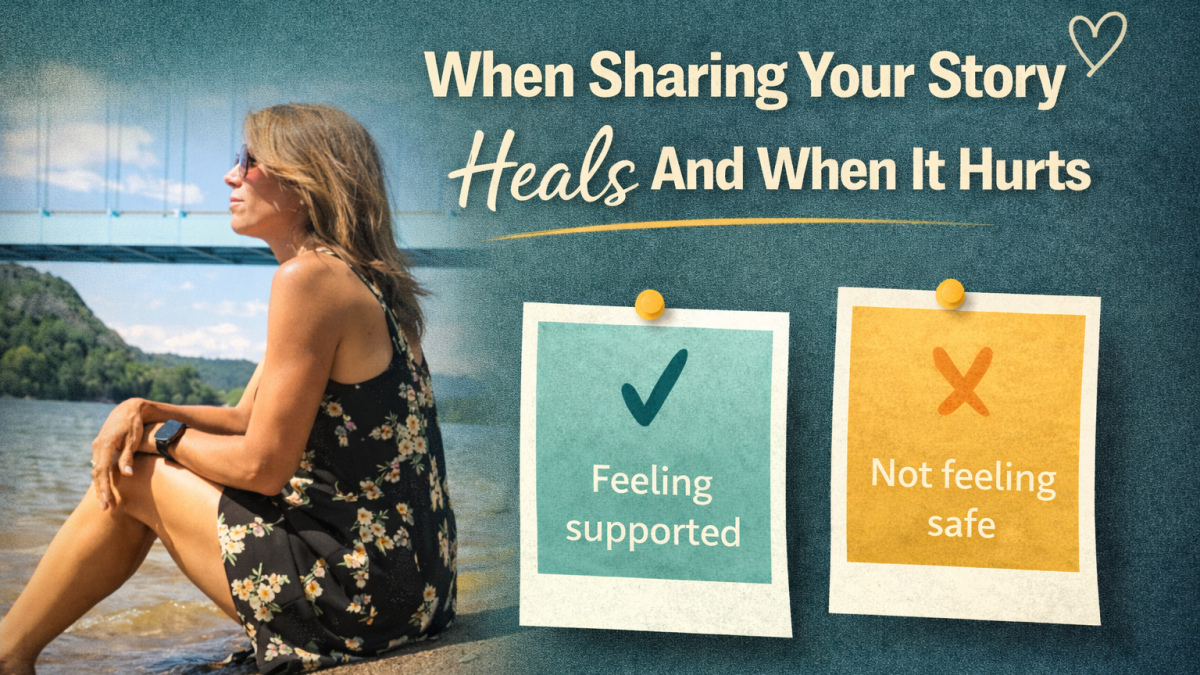
For some of us, telling our story too soon, too fast, or without the right support can actually retraumatize our nervous system.
Disclaimer: This blog is for educational purposes only and is not a substitute for professional medical or mental health advice. If you are experiencing severe distress, trauma responses, or medical concerns, please reach out to a licensed professional.
Why "Telling Your Story" Isn't Always Healing
(And How to Actually Release Trauma)
We’ve all seen the beautifully curated Instagram quotes and heard the well-meaning advice from friends: “Just speak your truth! Tell your story to heal!”
It sounds wonderfully simple, doesn't it? Just sit on a couch, spill your guts, cry a little, and walk out feeling fifty pounds lighter. But if you have ever tried to recount your deepest pain and ended up spending the next three days vibrating with anxiety, completely exhausted, or completely numb, I need you to lean in and hear this:
There is a massive biological difference between telling your story and reliving it.
One liberates you. The other keeps your nervous system trapped in a survival loop.
And yes, storytelling absolutely can be deeply empowering. It gives vital language to our pain, helps organize chaotic, fragmented memories, and offers meaning where profound confusion once lived. Telling your story can be one of the most powerful, beautiful parts of your healing journey... or, if done at the wrong time, one of the most painfully re-wounding.
The Truth We Rarely Talk About: Safety First
Here is the trauma-informed truth that few people talk about: Before we can safely find our words, we have to find our physical safety.
Because when the body still feels fundamentally unsafe, even the absolute truth can sound like a blaring threat alarm to your brain. Healing isn’t about white-knuckling your way through a retelling of your darkest moments. Healing is about releasing the trapped energy of those moments from the physical body.
When your nervous system is still flooded with cortisol and adrenaline, revisiting your trauma doesn't feel like processing the past. It feels like you are literally re-entering the burning building, rather than safely walking through the cool ashes after the fire has been put out. We do not have to re-live the agonizing pain to heal; our actual job is to help our body finally understand that the event is over.
The Sequence Matters: Biology Before Biography
I want to give you permission right now to let go of a massive burden: You do not have to dig into every single painful, gritty detail of your past to build a resilient future. You don’t need to “tell it all” to everyone in order to move forward.
In fact, sometimes forcing the story out prematurely is exactly what keeps the body locked in survival mode. In my own early therapy experiences, I would sit and repeat a painful story over and over again. I thought I was "processing." But I would leave the office feeling entirely depleted, shaky, and re-wounded. My mind was talking, but my body was panicking.
Building true resilience starts by gently dropping into the body, not just reciting the biography.
This somatic approach can take time, especially if you've lived a lifetime disconnected from your physical self, surviving purely from the neck up. Your body carries the heavy weight of the story long before your mouth ever forms the words to explain it.
When you finally learn to notice your breath, regulate your automatic stress responses, and create a genuine sense of internal safety... that is when the nervous system finally drops its guard and whispers, “Okay. It’s safe to remember now.”
That is the exact moment when telling your story becomes an act of fierce empowerment instead of a re-wounding tragedy.
When Your Truth Threatens Their Comfort
Now, let's talk about what happens when you finally do feel safe enough to speak. It presents a painful paradox: speak your truth, and you immediately risk being silenced.
Let’s be brutally honest: One of the hardest, most grief-filled parts of the healing journey is realizing that not everyone will celebrate your newfound voice.
When you start speaking your truth—especially if it involves childhood trauma, family dysfunction, abuse, heartbreak, or betrayal—some people will instinctively react with intense discomfort instead of empathy. They’ll shame you. They'll judge you. They will try to silence you to maintain the status quo.
- They abruptly change the subject.
- They minimize your pain ("It wasn't that bad").
- They gaslight you, calling you "too sensitive," "too negative," or "attention-seeking."
They’ll say things like:
“Why can’t you just get over it already?”
“Everyone goes through stuff—stop being so dramatic.”
“You really should just forgive, forget, and move on.”
“You’re making our family look bad by talking about this.”
Sound painfully familiar?
Here’s the absolute truth: their reaction isn’t about you.
It is entirely about them. It is about their own unhealed pain, their deep fear of exposure, and their profound discomfort with vulnerability. They mock you or silence you because, deep down in places they won't admit, they envy the sheer courage it takes to speak up.
But make no mistake:
There is absolutely nothing wrong with telling your story.
Speaking is a vital part of integration and healing. Silence protects the pain; it protects the abusers; it protects the dysfunction. Silence does not protect people.
The Generational Roots of Silence
Many of us grew up in families where silence was the ultimate survival tool. We learned the unspoken rules of the house very early on:
“Don’t talk about what happens at home.”
“Just smile and pretend everything’s fine.”
“Strong people don’t cry or show their emotions.”
So when someone finally breaks that generational pattern—when you do the brave, terrifying thing they never had the courage or freedom to do—it deeply activates their nervous systems.
Your truth literally shakes the fragile, heavily guarded system they’ve built to avoid facing their own pain.
The Point Was Never Attention... It Was Freedom
If you’ve ever been told, “You talk too much about your pain,” or “Stop seeking attention,” please hear this loud and clear:
You are not seeking attention. You are seeking freedom.
- You are learning to regulate your body.
- You are actively integrating your story into your life instead of being ruled by it from the shadows.
- You are breaking generational chains of silence and modeling true healing for the ones who come after you.
And that, my friend, is sacred work.
When People Try to Keep You in the Box You’ve Outgrown
Not everyone will see how far you’ve come. Some people will fiercely attempt to keep you in a tiny box labeled with your past mistakes, your old coping mechanisms, or old versions of you—especially if they haven’t done a shred of their own inner work.
That’s okay. Let them.
You do not have to prove your healing to anyone. You do not owe anyone the old, shrinking, people-pleasing version of yourself to make them comfortable. You do not need to justify your boundaries or your healing to those who are still fiercely protecting their pain.
We are all doing the absolute best we can with the awareness we currently have. And when we know better, we do better.
Where the Real Healing Begins...
Real healing begins when we stop judging how people express their pain and start listening to what that pain is desperately trying to protect.
Because behind every frustrating behavior, every "overreaction," and every messy story is a nervous system just doing its brilliant best to survive. And every single time we choose empathy over judgment—for ourselves and for others—we help someone else remember that healing is possible.
So keep speaking, but do it in a way that honors your physical body’s pace. You don’t have to rush the telling of your story. It will unfold beautifully and naturally when safety leads the way.
Because the ultimate goal was never to tell the story perfectly.
It was to live a life that no longer feels the need to hide it.
Ready to find safety so you can finally heal?
For some of us, healing doesn’t always start with talking. It starts with learning to feel safe enough in our own bodies to listen. If this resonates, I invite you to explore these next steps with me:
You don't have to do this alone. Let's start the journey home to your body.
Categories: : Empathy, Resilience, Stress, Trauma
Sign Up for our Newsletter
Wellness rooted in safety and connection for families, moms-to-be, and childcare professionals. Science-based tools to ease stress, build resilience, and support healthy development.