Burnt, Not Broken Method (BNB)
Built from lived experience and informed by science to help people move forward with more understanding, more support, and less pressure.
Burnout rarely happens because someone is weak. More often, it happens when a person has been carrying too much for too long without enough support.
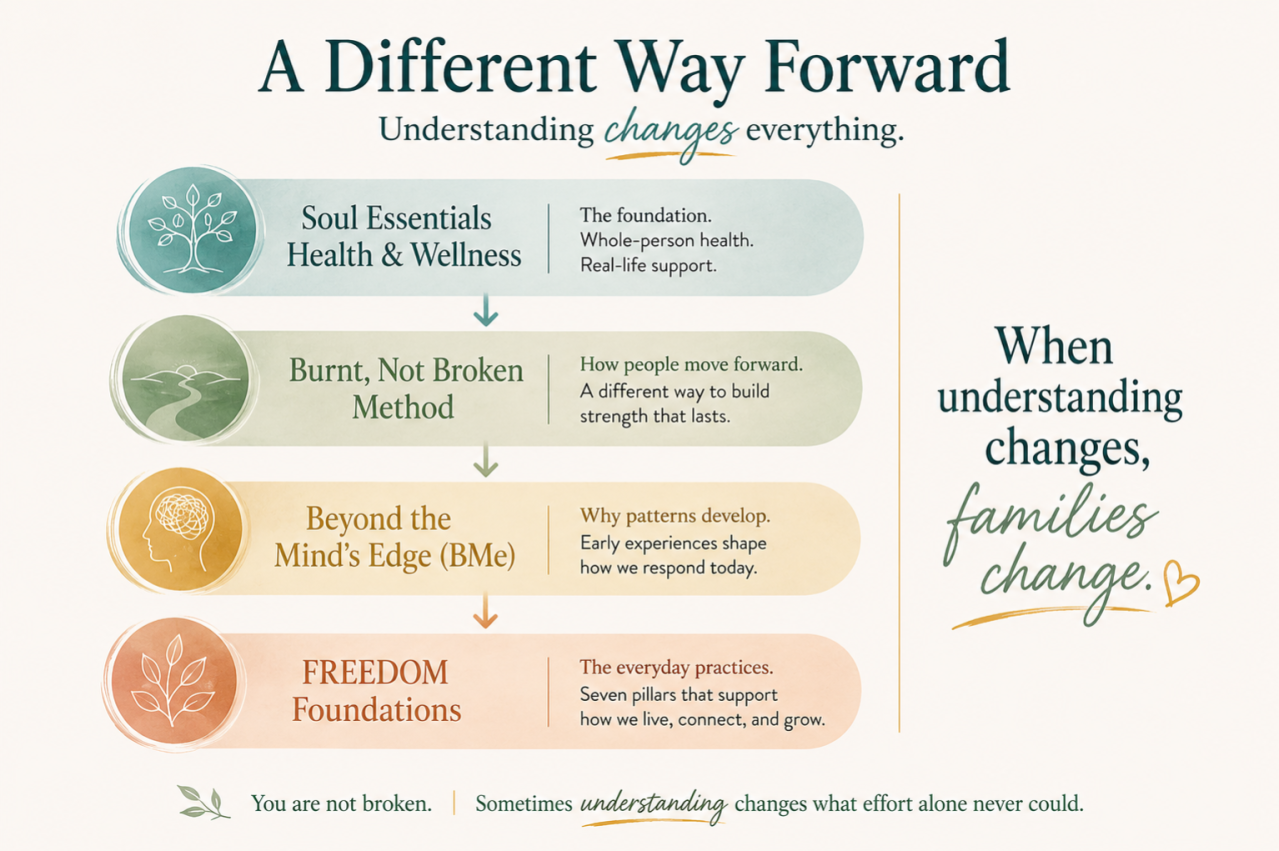
Why So Many Capable People Burn Out
The people most likely to burn out are often the ones who are responsible, driven, and deeply committed to the people and work that matter to them. They keep going when things are hard. They carry more than their share. They push through exhaustion because others are depending on them.
Over time, this constant pushing begins to take a toll—not because they lack discipline, but because they’ve been carrying too much for too long without enough support, recovery, or room to replenish.
The Pattern That Often Leads to Burnout
Many people who struggle with burnout aren’t lazy, careless, or doing life wrong. Often, they learned early to become the one who:
• Work harder
• Takes care of others
• Stays strong
• Keep going even when they were tired
• Handles things on their own
These qualities can become strengths. They can support success in school, work, caregiving, and relationships. But over time, they can also make it easy to miss what our body and emotions may be trying to tell us.
Things like:
• Constant tiredness
• Feeling overwhelmed
• Irritability
• Difficulty slowing down
• Feeling disconnected from yourself
• Needing rest, support or space
Instead of responding to those signals, many people learn to push through. For a while, it works.
Until one day, the same strengths that helped them keep going begin making life feel harder than it should.
When Life Demands More Than We Can Sustain
Every person has a limit to how much they can carry before life starts feeling harder than it should.
Our ability to handle life’s demands is shaped by many things, including:
• Early life experiences
• Sleep quality
• Nutrition and energy production
• Emotional support and connection
• Environmental stressors
• The pace and pressure of modern life
When these areas are supported, we’re better able to handle stress, adapt, and recover. But when demands increase faster than recovery and support, the gap begins to grow. Life demands keep rising. Recovery does not keep up.
Over time, the body begins spending more energy keeping up than recovering.
At first, people compensate by pushing harder.
They drink more coffee.
Sleep a little less.
Work longer hours.
Ignore the early warning signs.
But eventually, effort alone is no longer enough. Burnout symptoms begin to appear. Not as a failure of willpower, but as a sign that the demands have outpaced what the body can sustainably carry.
Understanding this gap is often the first step—not toward trying harder, but toward creating more support than strain. Over time this imbalance leads to:
• Chronic exhaustion
• Brain fog
• Anxiety
• Irritability
• Sleep disruption
• Loss of motivation
• Emotional overwhelm
These symptoms are not random. They may be signs that the body has been carrying more than it can sustainably support for too long
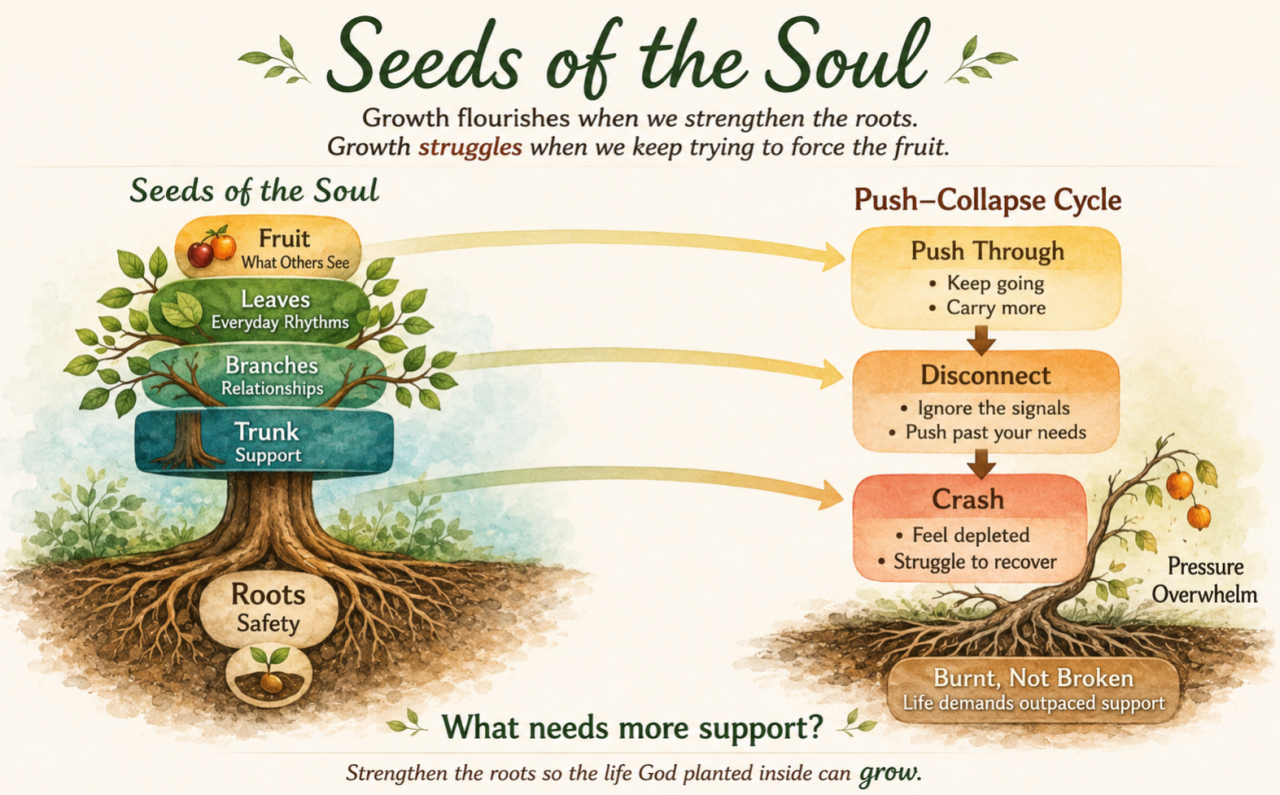
Why Burnout Can Feel Like a Roller Coaster
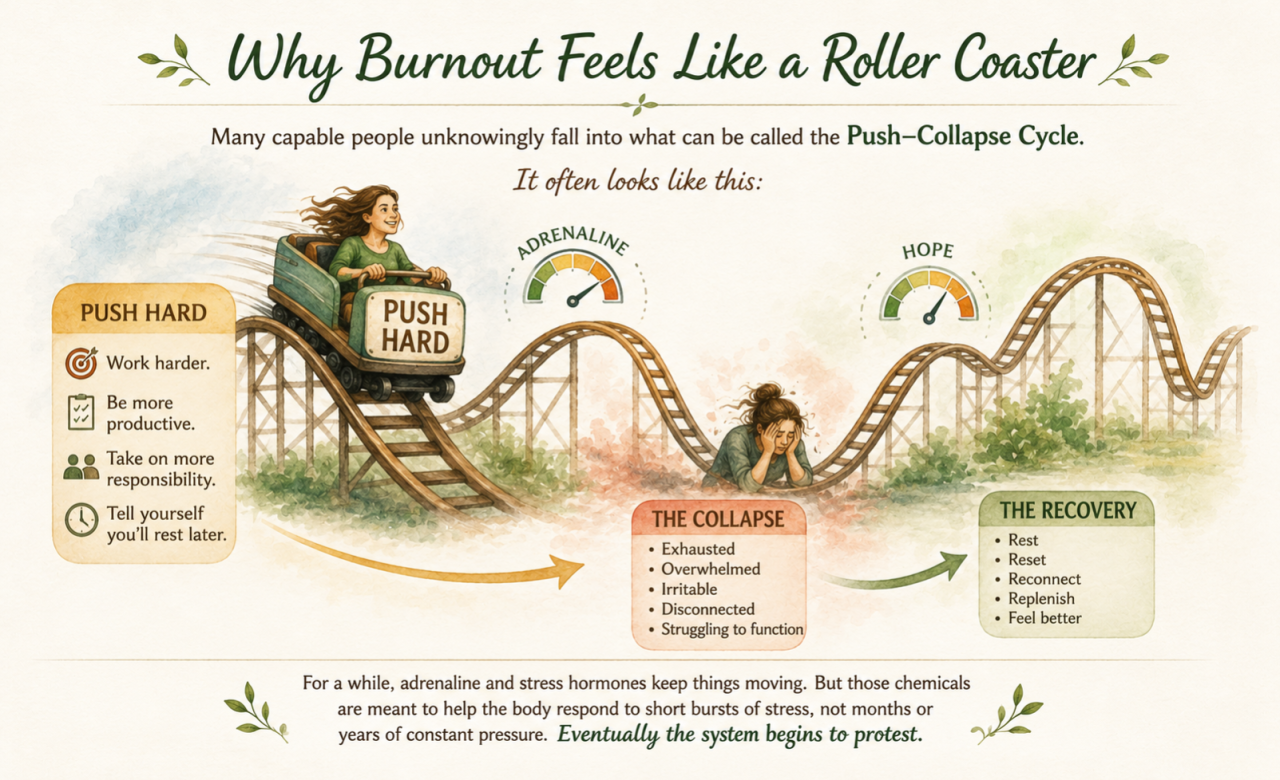
Many capable people slowly find themselves stuck in what I call the Push–Collapse Cycle.
It often looks like this:
Push through.
Keep going.
Take on more.
Tell yourself you’ll rest later.
Repeat.
For a while, stress chemistry helps keep things moving. But these responses were designed to help us get through short periods of stress—not carry months or years of constant pressure. Eventually, the body starts asking for what it needs.
Push Past the Signals
The signs start showing up.
• More tired than usual
• Harder to think clearly
• Sleep feels less restorative
But instead of slowing down, many people do what they’ve always done—they push through.
They tell themselves they’ll rest later, push through the exhaustion, and keep going.
Often this gets praised as dedication, strength, or resilience. But over time, it can come at a cost.
Eventually, the body no longer has enough support to keep compensating.
• Energy feels depleted
• Motivation becomes harder to access
• Simple things start feeling harder than they should
People often describe this stage as hitting a wall. But this isn’t weakness—it may be the body asking for more support than pushing can provide.
Once people begin to recover slightly, the cycle often starts again: Push → Override → Collapse.
Until something changes beneath the surface.
Burnt, Not Broken
A Different Way to Understand Burnout
Most people assume burnout means they’re doing something wrong.
They believe they should be stronger, more disciplined, or better at managing stress.
But burnout is rarely about character, discipline, or effort.
It is often the predictable result of a nervous system that has been under pressure for too long without enough restoration.
Symptoms like exhaustion, irritability, anxiety, brain fog, and emotional overwhelm are not random. They may be signs that the body has been carrying more than it can sustainably support.
The body may be asking for something different. More rest. More support. More room to recover.
This is why the core message of this work is simple: You are not broken. Sometimes understanding changes what effort alone never could.
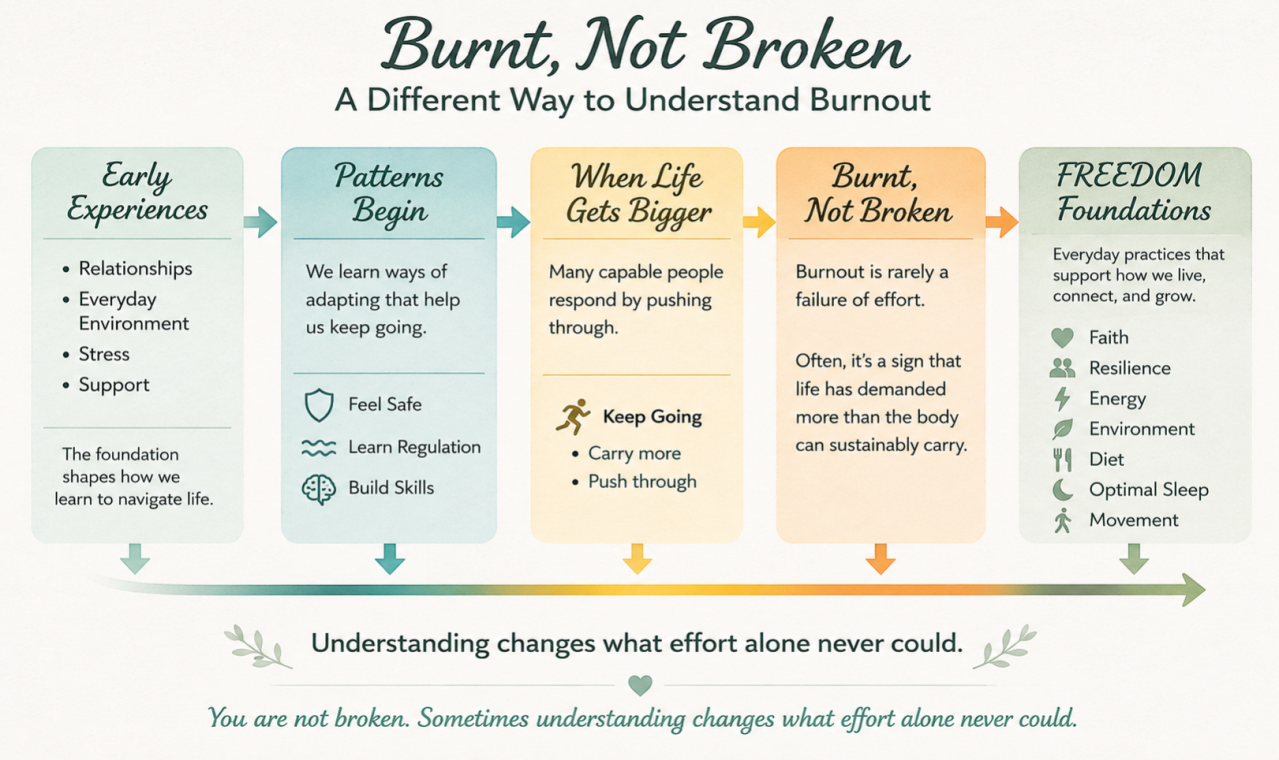
Burnout does not mean you are broken. Sometimes understanding changes what effort alone never could. The Burnt, Not Broken Method is built on a simple idea: when people better understand stress, support, and what their body has been carrying, different choices become possible.
The Burnt, Not Broken Method
Moving Forward With More Understanding
The Burnt, Not Broken Method focuses on creating more support than strain—through practical, evidence-informed approaches that fit real life. Instead of asking people to push harder, the method offers a different way of understanding stress so people can move forward with more energy, connection, and resilience. The method integrates three core ideas:
1. Early Experiences Influence How We Respond to Life
Our early experiences influence how we learn to respond to stress, relationships, responsibility, and change. These responses are not permanent—they can become easier to understand over time.
2. Burnout Happens When Demands Outpace Support
Burnout is rarely about motivation or effort. More often, it develops when life keeps asking for more than we have support, recovery, and energy to sustain.
3. More Support Creates More Possibility
When life includes more support, recovery, connection, and sustainable rhythms, people often begin feeling more like themselves again. This is where the FREEDOM Foundations come in.
The FREEDOM Foundations
The Conditions That Allow Capacity to Rebuild
When the body experiences safety, support, and replenishment, the nervous system can begin to restore balance. This is where the FREEDOM Foundations come in.
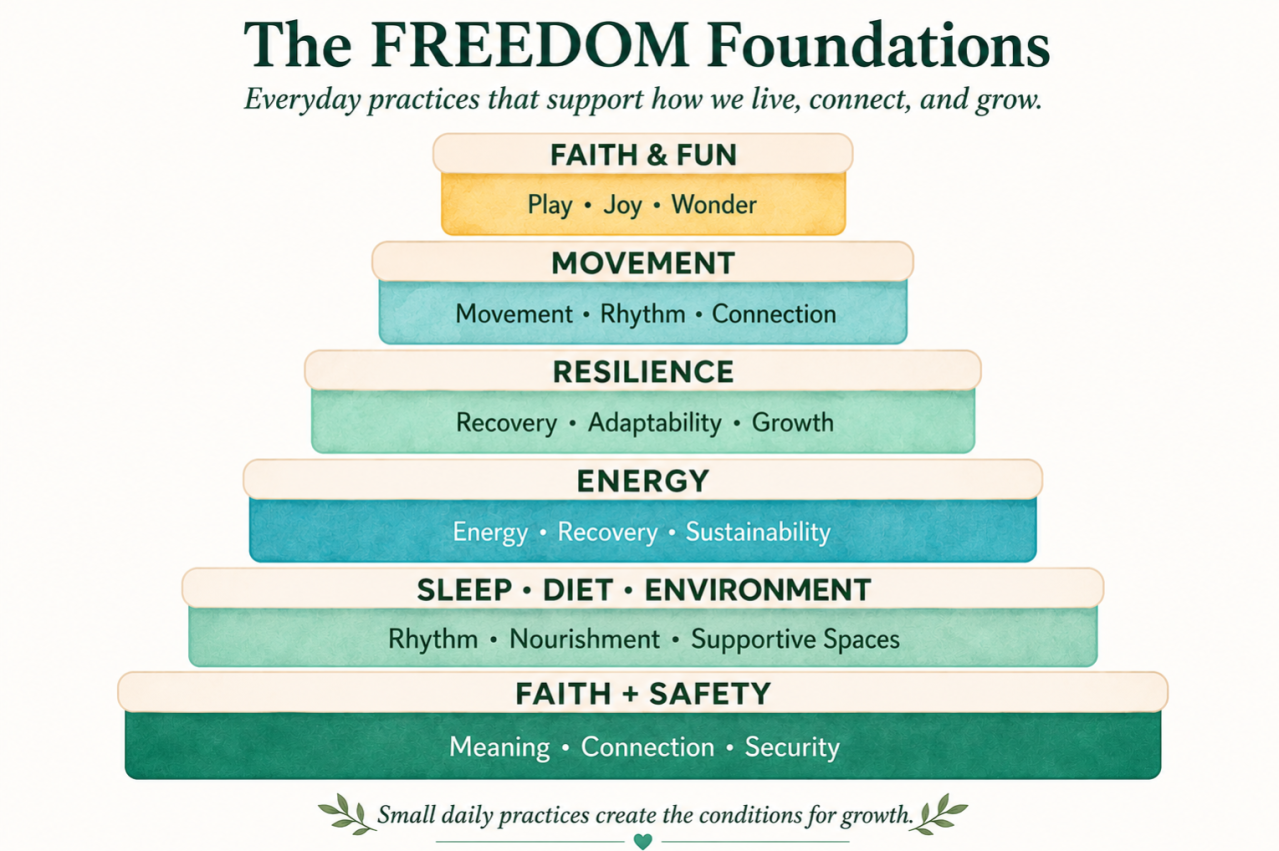
Moving forward is about more than taking a break. It happens when life begins creating more support than strain.
The FREEDOM Foundations are everyday practices that support how we live, connect, and grow.
Faith & Fun
Meaning, joy, play, and connection create space for life to feel lighter and more grounded.
Resilience
Building flexibility, recovery, and confidence through everyday life.
Energy
Supporting the energy needed to think clearly, connect well, and meet life’s demands.
Environment
Creating supportive spaces, rhythms, and inputs that influence how we feel and function.
Diet
Simple, nourishing choices that support energy, focus, and overall well-being.
Optimal Sleep
Sleep creates space for rest, recovery, and showing up as ourselves more consistently.
Movement
Movement supports energy, rhythm, and feeling more connected to ourselves.
Together, these foundations create everyday opportunities to feel more supported, more connected, and better able to handle life as it is.
What Moving Forward Can Look Like
Change rarely happens overnight. More often, it begins with small shifts that create more support, more awareness, and more sustainable ways of moving through life. Over time, some people begin noticing things like:
- Feeling more like themselves again
- More steady energy
- Better rest
- Feeling less overwhelmed by everyday life
- More patience, flexibility, and connection
You Are Not Broken
When life feels hard for a long time, it can start feeling personal.
But this experience is more common than most people realize—especially among people who care deeply and carry a lot.
The good news is that feeling overwhelmed does not mean something is permanently wrong.
When life includes more support than strain, people often begin feeling more connected, more supported, and better able to meet life as it is.
Burnt, Not Broken is built on a simple idea: You are not broken. Sometimes understanding changes what effort alone never could.
Free to BMe
My story is what happens when burnout doesn’t just interrupt your life—it dismantles what you spent decades building and forces you to ask questions you never knew to ask.s is
For most of my life, I thought more effort, more learning, and more love would make things feel easier. I believed if I worked hard enough, cared deeply enough, and learned enough, things would eventually settle into place.
Instead, life invited questions I never expected to ask—even with years of experience, education, and every reason to believe I was doing everything “right.”
What followed wasn’t one breakthrough moment. It was a gradual shift in how I understood stress, expectations, responsibility, and the quiet ways many of us learn to keep going long after we needed support. I can see now that I wasn’t failing. I was carrying more than I understood—and trying to solve it with more effort, more learning, and more love.
What felt confusing slowly became clearer. The stress wasn’t random. The overwhelm had roots. The patterns weren’t personal flaws—they were learned, practiced, and reinforced long before anyone had language for them. Looking back gave me language I didn’t have then—not to judge the past, but to move forward differently.
Now, I offer women a different way of understanding themselves—not as something to fix, but as something worth understanding. I bring together lived experience, more than 30 years across healthcare, care coordination, leadership, coaching, and community support, along with a deep curiosity about how our experiences shape the way we live, connect, and move through life.
My approach is grounded, practical, and realistic for real life—with enough lightness to remind us we don’t have to carry everything so seriously. That perspective became the foundation of the Burnt, Not Broken Method and the FREEDOM Foundations—everyday practices that support how we live, connect, and grow.
Burnt? Maybe.
Broken? Never.
What We Do
The women I work with are often raising children, managing households, and balancing work and family responsibilities. They don’t need complicated wellness routines—they need practical tools that meet them where they are.
Today my work focuses on supporting women to understand the hidden patterns that quietly lead to burnout so they can rebuild their capacity and show up differently in their lives and families.
When a mother’s nervous system becomes more regulated, the ripple effect reaches far beyond her own well-being. Children benefit.
Relationships shift. Families grow stronger. Because when women understand the connection between stress, nervous system regulation, and early life experiences, they gain the ability to break the push–collapse cycle and create a healthier path forward—for themselves and for the next generation.
Your kitchen is the heart of your home and of your health. Let’s kick the confusion out of the kitchen. We’ll put together a game plan for grocery shopping, meal prepping, cooking (yes, even the ‘what’s for dinner?’ panic), so you can make mindful, feel-good food choices without losing your sanity....
or living off cereal.
From restful sleep to navigating life’s challenges with confidence, your daily choices play a big role in your health. I’ll guide you in building habits that nurture your energy, boost your confidence, and encourage self-compassion—helping you create a life that feels vibrant, sustainable and in harmony. Resilience is possible!
By combining science-based strategies with a holistic approach, we tap into the power of awareness to drive lasting transformation. When you understand how your mind, body, and emotions work together, change becomes natural—helping you thrive in ways that truly align with your needs.
Credentials
Vicki Johnson, MS, BSH, CFHC – Trauma-Informed Certified Functional Health Coach
As a mother of two and a grandmother of three, I bring both professional training and real-life experience to my work with women and families.
My goal is simple: To help women move out of survival mode and build the nervous system capacity needed to live with greater energy, clarity, and connection.
- Trauma-Informed Certified Functional Health Coach
- Specialized and high-level training in the Biology of Trauma
- Master’s Degree in Organizational Leadership
- Bachelor’s Degree in Health Administration
- Certified Mental Wellness Coach
- HOPE Facilitator
- Brazelton Touchpoint Trained
- Specialized Training in Youth Mental Health and Family-Centered Development
- Co Author- Research and Community Engagement Supporting Families and Early Childhood Well-Being