What Happens in Vagus.....Doesn't Stay in Vagus
 Vicki Johnson
Anxiety. Gut issues. Brain fog. Burnout. They might seem unrelated — but they all run on the same wiring: your vagus nerve and nervous system signals.
The Body’s Built-In Safety System
The vagus nerve plays a key role in how the nervous system responds to stress and recovers from it. When this system is functioning well, the body can return to calm after difficult experiences.
If you're anything like me, you've probably spent years trying to mindset-hack your way out of anxiety, burnout, or that heavy, exhausting feeling of complete shutdown. But what if I told you that your pain, your hypervigilance, and even your absolute collapse aren't moral failures or signs of weakness? They are perfectly orchestrated alarm signals designed by your biology to keep you alive.
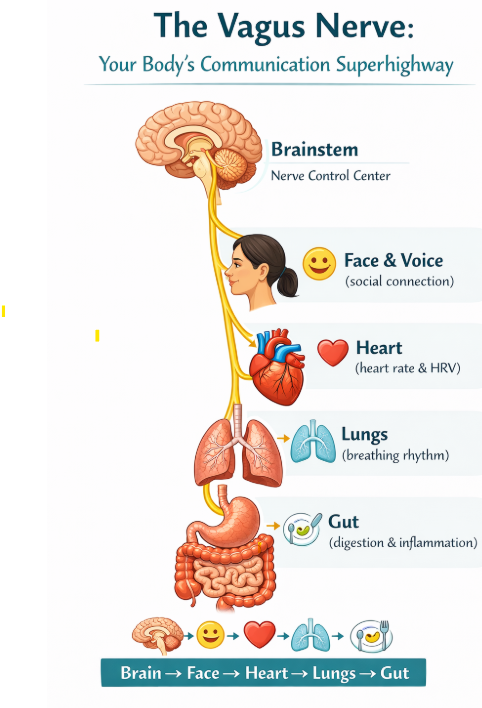
Enter the vagus nerve. Known in the medical world as the "wandering nerve," it is the superhighway of communication between your brainstem and your major organs—your heart, lungs, and digestive tract.
Its primary job? To constantly ask three questions:
- Am I safe?
- Should I fight (or run)?
- Should I shut completely down?
Here is the absolute wild part: About 80% of vagus nerve fibers carry information FROM the body TO the brain, not the other way around. Let that sink in. Your body is the one calling the shots, constantly updating your brain on whether or not you are safe. If your body senses danger, it doesn't matter how many positive affirmations you chant in the mirror; your brain is going to hit the panic button. This completely flips the script on how we handle nervous system healing.
The Three Faces of Your Nervous System
Science, specifically viewed through the Polyvagal Theory lens, shows us exactly how this incredible nerve dictates our daily lives. Dr. Jessica McGuire beautifully describes the vagus nerve's functions in terms of brakes on a car. The Ventral Vagal state is a gentle brake helping you slow down and connect, while the Dorsal Vagal state is pulling the emergency brake at 80 miles per hour because the overwhelm is just too much.
Let’s break down the three states of the nervous system and what they actually feel like in real life.
| Nervous System State | Vagus Role | What It Feels Like |
|---|---|---|
| Ventral Vagal | Social connection | Calm, safe, engaged, open |
| Sympathetic | Mobilization | Anxiety, fight/flight, restless |
| Dorsal Vagal | Shutdown | Freeze, collapse, numbness |
1. Ventral Vagal (Safe & Connected)
Imagine you’re sitting in a cozy coffee shop with a dear friend. The lighting is warm, the coffee is exactly how you like it. You’re laughing, your shoulders are dropped, and you're breathing easily. Your body feels open, present, and entirely human. In this moment, your nervous system is humming a sweet melody that says, “Everything is okay.”
2. Sympathetic (Fight or Flight)
Now, picture this: You finally sit down to eat dinner after a ridiculously long day, but you just had a highly stressful, tense argument with your partner or boss. Suddenly, your stomach feels like it's tied in a knot. That delicious meal doesn’t sound good anymore, and your digestion feels completely off. What happened? Your vagus nerve just sent an urgent text message to your gut: “Now is NOT the time to digest a casserole, Brenda—we might have to fight a bear!”
3. Dorsal Vagal (Shutdown/Freeze)
Let's take it a step further. Imagine the stress doesn't stop. It piles on all day, every day. Eventually, you stop responding to text messages. Your limbs feel like they're filled with wet cement. You want to hide under a blanket, turn off your phone, and just disappear from the world. Your nervous system has officially said, “This is too much. Shut things down.”
It's vital to understand that this freeze or shutdown response is not laziness. It is your biology desperately trying to conserve energy and protect you from a world it perceives as fundamentally unsafe.
Why Pain is an Overzealous Smoke Detector
As pain neuroscience expert Dr. Jessica McGuire emphasizes: Pain doesn't always equal tissue damage. It is an alarm signal, and often it goes off way before an actual injury occurs. The equation is simple but frustrating: The more threat the brain perceives, the louder the alarm.
Notice the key word there: perceives. What the brain perceives as a threat does not always equal present-day reality. This is nervous system biology at its core, and it perfectly explains why trauma shows up in the body. If you are a trauma survivor dealing with chronic pain, migraines, IBS, or fibromyalgia, you are not crazy. Your brain is stuck predicting danger, whether real or perceived, making pain a protective output of the nervous system, not just a physical injury.
The Vagus Nerve & Hidden Inflammation
If you've ever wondered why chronic stress makes you physically sick, look no further than the vagus nerve's role in inflammation. The vagus nerve acts as a master regulator for your body's inflammatory response.
When your nervous system feels safe, it acts like a cooling balm, calming inflammation down. But when your nervous system feels threatened for long, uninterrupted periods of time, that inflammatory response gets stuck in the "ON" position. This is the missing link explaining why trauma stored in the body heavily impacts physical health and longevity. Your brain, your immune system, and your nervous system are not separate roommates; they are a deeply connected triad.
The Social Engagement System: Why We Need Each Other
We live in a culture that worships fierce, solitary independence, but our biology begs to differ. The vagus nerve literally links your heart to your face, controlling your voice tone, facial expressions, and eye contact. This is known as the Social Engagement System.
We are designed to regulate each other. Babies do not learn to self-soothe in a vacuum; they have to borrow a regulated caregiver’s nervous system to learn how to calm down. Organizations like Zero to Three emphasize that responsive caregiving is the bedrock of early brain development for this exact reason. Emotional contagion is incredibly real. Calm spreads like a gentle wave, but stress spreads like a wildfire. Calm parents help create calm kids because kids are biologically wired to borrow our nervous systems.
Childhood Wiring and the "Gas-Brake" Burnout
Children arrive in this world with a set of biological expectations. They expect to be seen, heard, touched, understood, and loved. When those basic, foundational needs are unmet or wildly unpredictable, vagal development takes a hit. The calm, connected ventral system doesn't mature the way it should. (For my fellow science geeks: the signals simply don't travel efficiently due to myelination issues).
This early disruption affects emotional regulation for the rest of your life. And here is a tough truth to swallow: Time doesn't heal nervous system dysregulation. New experiences do.
Categories: : Attachment, Bonding, Burnout, Stress, Trauma
Sign Up for our Newsletter
Wellness rooted in safety and connection for families, moms-to-be, and childcare professionals. Science-based tools to ease stress, build resilience, and support healthy development.