You Weren't Born That Way
 Vicki Johnson

Explore how early experiences can shape the patterns you mistake for personality
How early experiences become patterns you mistake for personality.
Maybe you’ve wondered why you keep ending up in the same place with a different person. You recognize the red flags sooner now. You know what you don’t want. You may have even promised yourself, never again. Yet somehow you find yourself back in a familiar role—trying harder, keeping the peace, proving your worth, taking care of someone who won’t take care of themselves, or convincing someone to give you the kind of relationship you keep hoping they will eventually become capable of giving.
It can be easy to look at those patterns and ask, What is wrong with me?
I think there is a more useful question: What did your brain and body learn a long time ago about love, safety, connection, and what you had to do to keep them?
One way to think about unaddressed trauma is as information from an overwhelming experience that has not been fully integrated into the nervous system. The experience may have happened years ago. The danger may no longer exist. But the brain and body can continue responding from what they learned when the danger was very real.
And some of those lessons began before you had enough language to explain what was happening.
Same Fall. Two Very Different Experiences.
Picture a little girl running through the yard. She trips, hits the ground, scrapes her knee and begins to cry.
An adult comes toward her, gets down close and notices what happened. “That looked scary. You fell pretty hard. I’m right here.” The adult checks her knee and stays nearby, allowing the child to show what she needs rather than telling her how she feels.
Maybe she reaches for the adult.
Maybe she cries for another minute.
Eventually her breathing begins to settle, and before long she is ready to return to what she was doing.
The fall still hurt. The adult didn’t erase the experience or tell her she was fine when her body was clearly saying something had happened. Instead, the child experienced something important alongside the scraped knee:
Something hard happened, and someone stayed with me.
I can be upset without losing connection.
I can move through something difficult and find my way back.
Her nervous system doesn’t only carry the experience of falling. It also gets an experience of connection, support and recovery.
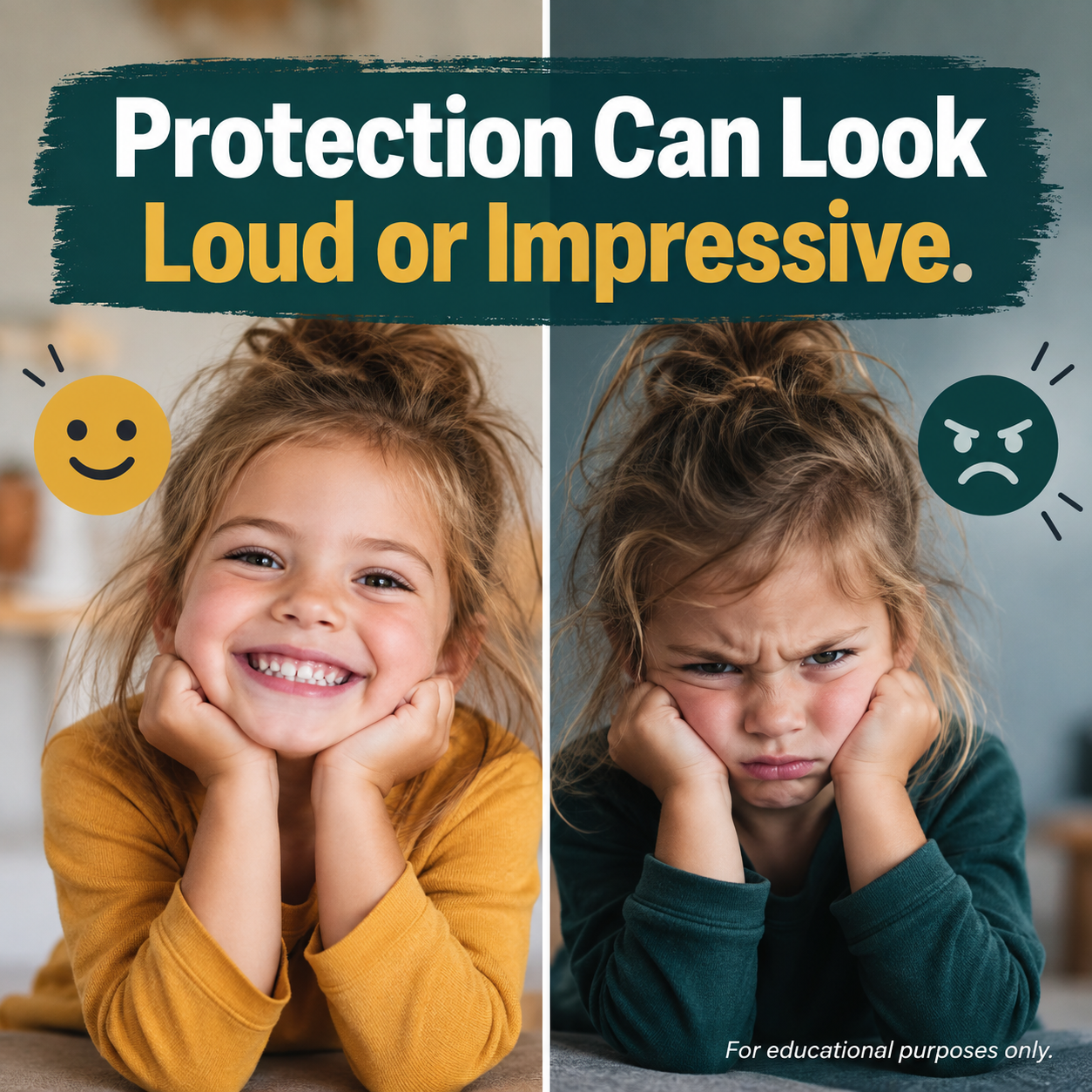
Now picture the same little girl. Same yard. Same fall. Same scraped knee.
An adult rushes over, but this time the response sounds more like,
“What were you thinking?
I told you not to run over there.
Stop crying.
You’re fine.
Look what you did.”
Maybe the adult was frightened and their fear came out as anger. Maybe they were already overwhelmed. Maybe this was exactly how distress was handled when they were young.
This isn’t about turning one parent into the good parent and the other into the bad one. Parents bring their own histories, stress, resources and nervous systems into these moments.
But the child’s developing brain still has to do something with the experience.
Now she isn’t only taking in the pain from her knee. She is taking in the adult’s face, voice, body posture and reaction. Without the developed brain of an adult to make sense of it, meanings can begin forming:
I did something wrong.
My feelings make things worse.
When I need someone, they might get angry.
I need to figure things out myself.
Maybe I shouldn’t need so much.
She isn’t sitting there consciously deciding any of this.
Her nervous system is learning through experience.
Long Before We Had Words
This matters because some of our earliest learning happened before we had the language—or the brain development—to understand what was happening around us.
A young child cannot think, Mom seems overwhelmed today, and her reaction probably has more to do with what she is carrying than with me.
The child experiences the moment.
The face changes. The voice gets louder. The muscles tighten. The stomach drops. Someone reaches toward them warmly or turns away. They are soothed, ignored, welcomed, criticized, protected, frightened, comforted or left to figure out what happens next.
Before we could explain our experiences, our bodies were already learning from them.
Over time, those repeated experiences become part of what the developing brain expects. They influence how we respond to closeness, conflict, mistakes, disappointment, uncertainty and other people’s emotions.
And the brain gets very good at what it practices.
Then the Child Becomes an Adult
The little girl who repeatedly experienced connection during hard moments may grow into a woman who generally expects relationships to have room for mistakes, emotion and repair. Someone can be unhappy with her without that automatically meaning the relationship is in danger. She may be able to ask for support without believing that needing someone makes her weak.
That doesn’t mean she will never struggle or have a difficult relationship. Childhood experiences do not produce perfectly regulated adults.

They simply give the developing brain something to practice.
The second little girl may grow into an equally intelligent, loving and capable woman, but her nervous system may have practiced something very different: watch the room, stay ahead of other people’s emotions, don’t need too much, solve the problem quickly, keep everyone happy and handle things yourself.
Some of those adaptations may become genuine strengths.
She may be incredibly perceptive.
She notices small changes in people that others miss.
She may be independent, dependable and capable—the woman everyone calls when something goes wrong because she has learned how to handle things.
There is nothing wrong with those strengths.
Looking back over my own life, this is one of the distinctions I wish I had understood much earlier: a strength can be real and still be carrying an old job.
Being capable can quietly turn into I have to hold everything together. Compassion can become I am responsible for fixing everyone. Being dependable can turn into I cannot disappoint anyone. Independence can become I cannot need anyone. And being sensitive to other people can become I need to know everyone else is okay before I can decide whether I am.
When Familiar Starts Feeling Like Love
This is where early patterns can become particularly confusing in adult relationships.
If closeness was mixed with unpredictability, caretaking, rejection, fear or having to earn connection, you may find yourself pulled toward relationships that require those same familiar skills.
Not because you want to suffer.
Because you already know the role.
You know how to care for the person who always needs something. You know how to work harder when someone pulls away. You know how to study another person’s mood and adjust yourself accordingly. You know how to keep hoping that if you are patient enough, understanding enough, useful enough or loving enough, something will finally change.
Sometimes the younger wounded part of us is still trying to get a different ending to an old story: Maybe this time I’ll be chosen. Maybe this time I can make them stay. Maybe this time I can finally make an unsafe relationship safe.
When I look backward now, I can see places where what felt like compassion was sometimes over-functioning. What looked like loyalty could become staying too long. What felt like giving someone another chance could become ignoring information that was already right in front of me.
That perspective didn’t come from judging the woman I was then.
It came from finally understanding what she had learned to do.
This doesn’t mean every relationship choice can be traced neatly back to childhood. Human beings and relationships are far more complicated than that. But when the same pattern keeps showing up with a different person, it may be worth getting curious about what your nervous system learned to recognize as normal.
Familiar and safe are not always the same thing.
The Survival Strategy Wasn’t the Problem
When something overwhelming happens, the brain and body respond with whatever resources are available.
We might fight, run, shut down, become agreeable, go quiet, become fiercely independent, learn to read everyone in the room, keep the peace, work harder, need less or take care of everyone around us.
That natural drive toward self-preservation is a biological gift.
I think this is important because we can spend years criticizing ourselves for patterns that originally developed for a reason.
The problem wasn’t that you learned how to survive.
The problem comes when a strategy built for an old situation continues making decisions long after the situation has changed.
The child who learned that disagreement threatened connection may become an adult who knows exactly what she believes but still feels an enormous urge to fix the room after she says it.
She tells the truth. Someone gets quiet. Their face changes. There is tension in the room.
Suddenly she wants to explain more, soften what she said, apologize, send another text or make sure the other person is okay.
The honesty may not actually be the hardest part.
Staying present after telling the truth may be.
I understand that one differently now than I did years ago. Sometimes we think we need to become braver about speaking. What we may actually need is more ability to remain present after we speak, without immediately making someone else’s discomfort our responsibility.

When the Adult You Starts Choosing
Breaking an old cycle usually doesn’t happen through one dramatic realization. It happens when something that once operated automatically becomes something you can finally notice.
That begins with awareness.
You catch yourself thinking, I am trying to convince someone to treat me well. I feel responsible for changing their mood. I’m about to apologize because they’re uncomfortable, not because I did something wrong. I keep choosing people who need me more than they know how to love me.
Awareness gives us somewhere to begin.
Then comes regulation—learning to stay with the discomfort long enough that the old response doesn’t automatically make the decision.
Your heart may still race after you set a boundary. Someone’s silence may still feel awful. Every part of you may want to send another message explaining yourself.
Regulation isn’t pretending those sensations aren’t there. It is beginning to create enough room to recognize, This is uncomfortable, but uncomfortable does not automatically mean unsafe.
Then we build new skills. We learn to say no without adding five reasons. We learn the difference between compassion and rescuing. We recognize that another adult’s disappointment doesn’t automatically mean we did something wrong. We begin paying attention to whether a relationship is mutual instead of measuring its value by how much we are willing to give.
And then comes the part I think we often underestimate: repeated action.
You keep the boundary even when your body wants you to take it back. You stop chasing someone after they withdraw. You pause before automatically saying yes. You let another adult have their own feelings without immediately making those feelings your responsibility.
You may even find that healthy, consistent relationships initially feel less intense than the relationships that once kept you guessing.
That does not necessarily mean something is missing.
Sometimes peace simply feels unfamiliar when your nervous system has had a lot more practice with unpredictability.
With repetition, the brain and body begin learning something new: There are other ways to be in relationship. I have choices here.
You Cannot Do Another Adult’s Work for Them
This becomes especially important when you are dealing with someone who consistently refuses responsibility for their own behavior.
Not everyone who hurts another person is a narcissist, and narcissistic personality disorder is a clinical diagnosis. We don’t need a diagnosis, though, to recognize when someone repeatedly externalizes blame, refuses accountability or makes another person responsible for every conflict.
When you have spent much of your life taking care of people:
It's easy to believe there must be some combination of patience, explanation, compassion and effort that will finally make another person understand.
I know how tempting that belief can be:
If I explain it differently.
If I give one more chance.
If I can make them understand why this hurts.
We are not only making choices for the life directly in front of us. Sometimes we are changing what our children and grandchildren get to experience through us. A different response. A safer relationship. An apology. A repaired rupture. A boundary that says love does not require abandoning yourself.
Turning pain into wisdom does not mean calling the pain a gift.
It means understanding what you learned while surviving it and deciding what still belongs in the life you are building now.
The younger version of you did what she could with the brain, resources, relationships and choices she had available.
The adult you has more options.
And maybe one of the greatest blessings of moving forward is discovering that your story did not end where you were hurt.
"You are still there underneath everything you learned to do to survive—with more choice now about who gets to lead."
When Pain Becomes Wisdom
There is a woman underneath all the adapting, pushing through, proving, keeping the peace and figuring everything out on her own.
I know that woman differently now.
Looking back—as a woman, a mother and now a grandmother—I can see strength in places where I once saw only struggle. I can also see where some of that strength had been working overtime for years.
The woman underneath it all didn’t disappear.
Her brain and body became very good at protecting her.
There is strength in that story. But strength does not mean every survival pattern needs to stay in charge forever.
You may not have chosen what happened to you. If someone abused, violated or harmed you, responsibility for that behavior belongs with the person who chose it. You have every right to tell the truth about what happened and say, I was a victim of something I did not choose.
Naming what happened does not mean giving it ownership of everything that comes next.
There can come a day when you realize you get to choose more of what happens through you—the patterns you interrupt, the boundaries you build, the love you give differently and the things you refuse to pass forward.
That last part means even more to me from where I stand now.
We are not only making choices for the life directly in front of us. Sometimes we are changing what our children and grandchildren get to experience through us. A different response. A safer relationship. An apology. A repaired rupture. A boundary that says love does not require abandoning yourself.
Turning pain into wisdom does not mean calling the pain a gift.
It means understanding what you learned while surviving it and deciding what still belongs in the life you are building now.
The younger version of you did what she could with the brain, resources, relationships and choices she had available.
The adult you has more options.
And maybe one of the greatest blessings of moving forward is discovering that your story did not end where you were hurt.
You are still there underneath everything you learned to do to survive—with more choice now about who gets to lead.
The Woman You Find
Maybe moving forward isn’t about becoming a different woman at all.
Maybe it’s about finally recognizing what was you and what was learned in the places where you had to adapt, stay alert, keep the peace, prove your worth, or carry more than was ever yours to carry.
You don’t have to hate those old patterns to outgrow them. Many of them protected you, got you through, and even became some of your greatest strengths. But they don’t have to make every decision now.
Awareness gives you a chance to notice. Regulation gives you room to pause. New skills give you more options. And repeated choices begin showing your brain and body that the old way is no longer the only way.
That is how pain begins to become wisdom—not because what happened was good, but because it no longer gets the final say in what happens next.
“You may not have chosen what shaped you. But you can choose what you practice, what you carry forward, and who gets to lead now.”
Understand the patterns. Build new skills. Make room for different choices.
Categories: : Attachment, Bonding, Empathy, Relationships, Resilience, Stress, Trauma
Sign Up for our Newsletter
Wellness rooted in safety and connection for families, moms-to-be, and childcare professionals. Science-based tools to ease stress, build resilience, and support healthy development.