Why Young Children Don’t Have Willpower Yet: What Parents Should Know About Brain Development
 Vicki Johnson
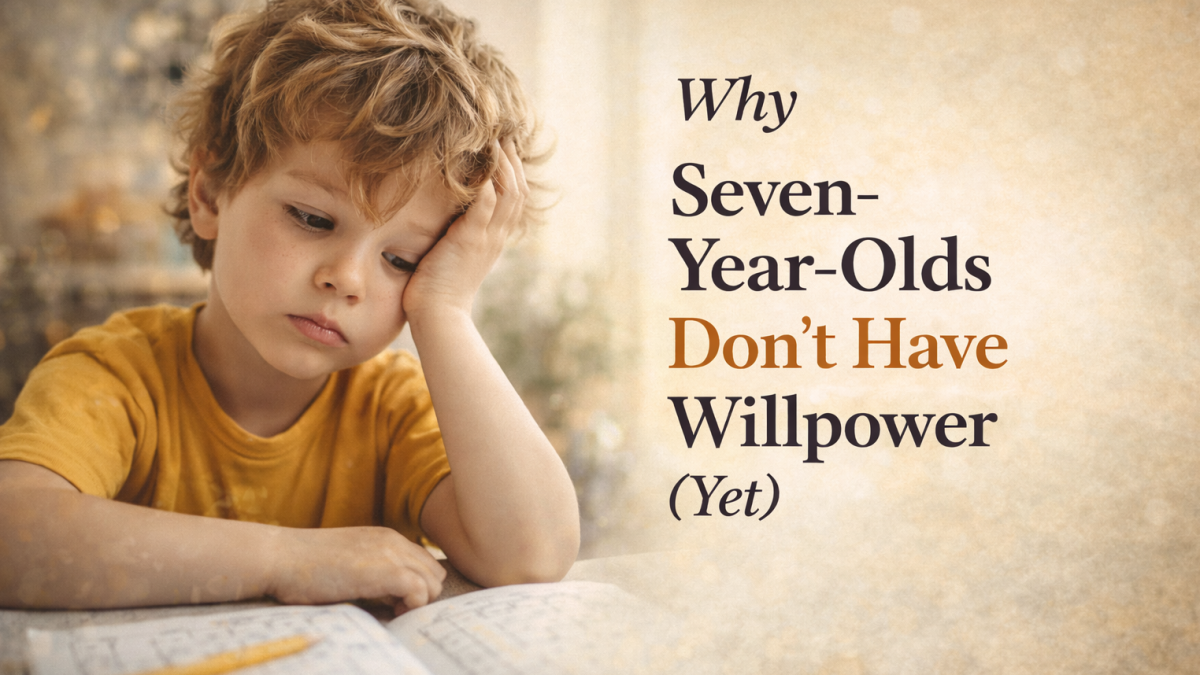
Seven-year-olds do not lack willpower. They lack neurological capacity. And honestly? Most adults do too....we just dress it up better.
Many parents wonder why young children seem to lack willpower or self-control. The truth is that the parts of the brain responsible for impulse control and emotional regulation are still developing.
Before we talk about willpower, toddler meltdowns, behavior charts, or asking kids to put on their “listening ears,” I want to tell you why this matters so deeply to me.
After suffering from severe, system-crashing burnout in 2023, I learned a very hard truth: My burnout didn’t start a few years ago—or even recently. It started decades ago.
By the time I became an empty nester, and subsequently a grandmother, my nervous system was already running on absolute fumes. If running on empty burned calories, I would have been a supermodel. It took severe burnout... the kind that physically humbles you, forces you into bed, and cracks your entire world wide open... for me to finally learn about nervous system dysregulation.
As painful and isolating as that season was, burnout gave me a profoundly unexpected gift. It became the catalyst that led me into advanced trauma-informed training and completely reshaped how I understand behavior, stress, biology, and healing.
And I’ll be honest with you—there is grief in that realization. I wish I had known this science decades ago. It would have changed my entire life. More importantly, it would have fundamentally changed how I parented my own children.
I was a young, highly dysregulated mom who made a million mistakes. Not because I didn’t care, and certainly not because I didn't love my kids fiercely, but because I simply didn’t have the language, the somatic tools, or the support. I was raising kids while my own body was stuck in survival mode. My hope now is to leave a legacy that includes more than just passing down generational trauma.
I can’t turn back time. None of us can. But I can share exactly what I’ve learned with anyone who will listen. Because when we finally know better, we do better.
And this information? It shouldn't be a secret kept in therapists' offices. It should be shared with every single parent, grandparent, caregiver, childcare worker, and medical provider walking the planet.
When Big Feelings Live in Little Bodies (Birth to 7 Years)
Why “Willpower” Doesn’t Exist for Seven-Year-Olds (And What to Do Instead)
A Morning You Probably Recognize All Too Well
Let's set the scene. It’s 8:12 a.m. on a Tuesday. You are already running late.
Your toddler is on the kitchen floor sobbing as if the world has ended because the banana broke in half when you peeled it. Your preschooler is melting down by the front door because the seam on their socks feels “wrong” and their shoes are suddenly instruments of torture. The dog is barking at the mail carrier. Your coffee is cold. And your own nervous system is already buzzing with high-voltage anxiety—and the day has barely even started.
In moments like this, as you stare at the broken banana and the screaming child, you might wonder, Why is this so hard? Why does every morning have to be a battle? Or you might quietly think to yourself, Other kids seem to handle this better. What am I doing wrong?
Let me gently reframe this for you:
Young children don’t misbehave because they simply won’t cope.
They struggle because their bodies physically can’t cope yet.
The Nervous System Story (In Plain, Fluff-Free Language)
We talk a lot about "willpower" and "self-control" in our society, but we rarely talk about where those things actually live. Willpower lives directly in the prefrontal cortex. This is the sophisticated "CEO" of the brain, responsible for impulse control, logical reasoning, emotional regulation, and rational decision-making.
Here is the biological catch that changes everything:
- 👉 In children under the age of seven, that part of the brain is essentially a massive construction zone. It is not fully online. It is not fully wired.
- 👉 In fact, modern neuroscience tells us that the prefrontal cortex continues developing well into a person's mid-20s.
So, when we look at a hysterical four-year-old and tell them to “just calm down,” “make better choices,” or “try harder to listen,” we are quite literally asking them to use a biological system that does not exist in their head yet. We are asking a tricycle to perform like a Ferrari.
That is not childhood defiance. That is not them being manipulative or "naughty." That is standard developmental biology.
Think of the nervous system exactly like a cell phone battery. When a child's capacity (their battery) is fully charged and high, they can handle the frustration of a broken banana. They might whine, but they recover. But when their capacity is low—because they are tired, hungry, overwhelmed, or sensing your stress—everything feels like a massive, life-threatening emergency. The broken banana isn’t actually the problem. It is just the last drop in an already overflowing cup.
The Calm & Coping Dashboard: What’s Going On Inside
If we want to stop battling behavior, we have to start looking underneath it. Behavior is just the tip of the iceberg; biology is the massive mountain of ice hiding beneath the water. Here is what is actually happening when your child seems to be losing their mind over "nothing."
| What’s Going On Inside (Biology) | What Parents See (Behavior) | Why It Matters |
|---|---|---|
| Blood sugar dips / poor sleep | Massive meltdowns over “nothing” (like the wrong color cup) | The brain requires literal fuel and rest to stay calm and rational. No fuel = panic mode. |
| Gut health imbalance | Unexplained anxiety, irritability, or chronic sleep trouble | The gut produces the vast majority of our calming neurotransmitters (like serotonin). An upset gut equals an upset brain. |
| Elevated stress hormones | Bouncing off the walls (hyperactivity) or totally shutting down and ignoring you | The body physically thinks a predator is near and is preparing to fight, flee, or freeze. |
| Nervous system overload | Explosive anger, hitting, biting, or deeply withdrawn behavior | Biological protection completely overrides logic. The child is surviving, not thinking. |
Behavior is not random. It’s biological feedback.
How ACEs Fit In (Gently Explained)
We cannot talk about the childhood nervous system without talking about the environments that shape it. Early stress or adversity—often referred to in the medical world as ACEs (Adverse Childhood Experiences)—fundamentally alters how a child's brain develops.
ACEs aren't just the "big, bad" traumas we see in movies. They can include things like early medical interventions, chronic family stress, parents arguing frequently, moving houses often, or separation from a caregiver. When these events happen early in life, a child’s body can get stuck running in survival mode.
That lowers their baseline capacity. It means they may react much faster to small stressors, recover much slower from upsets, or seem “extra sensitive” to the world around them.
👉 But hear me clearly: This is not a life sentence. The human nervous system is neuroplastic and remarkably adaptable—especially in childhood. Healing is entirely possible when we introduce safety.
Why Behavior Is All About Capacity and Demand (The Invisible Backpack)
Behavior isn’t just about how much capacity (or battery life) a child has on a given day. It’s also about how much is actively being demanded of their system at one time. Imagine every demand is a heavy rock placed into a tiny backpack the child has to wear. Eventually, the child collapses under the weight.
| Type of Demand (The Rocks) | What It Looks Like in Real Life | Why It’s So Exhausting |
|---|---|---|
| Sensory | Bright grocery store lights, itchy tags, loud noises, crowded spaces | Young brains cannot easily filter out background input. It's all coming in at 100% volume. |
| Emotional | Feeling sad, disappointed, or transitioning from play to bedtime | Emotional regulation is borrowed from adults, not internal yet. They need us to ground them. |
| Cognitive | Following multi-step instructions ("Go get your shoes and brush your teeth") | Thinking hard actually physically drains the brain's regulation energy. |
| Physiological | Being hungry, thirsty, hot, cold, or tired | Biology will always, always win over behavior. Always. |
What Parents Often Miss: Demand Stacking
Most massive meltdowns do not happen because of one single thing. They happen when multiple demands stack on top of each other at the exact same time. Think about your own adult life: you can handle dropping your keys. But if you drop your keys while holding a hot coffee, answering an urgent text from your boss, running late, and on four hours of sleep? You're going to lose your mind.
For a child, it looks like this: low blood sugar + a loud environment + a rushed, stressed caregiver telling them to hurry up. The meltdown over the shoes is not the problem; it’s the signal that the system has crashed.
The Simple Math of the Nervous System:
- ✅ High capacity + high demand = manageable stress
- ✅ Low capacity + low demand = relative calm
- ❌ Low capacity + high demand = total dysregulation & meltdown
What Actually Helps in the Heat of the Moment
When the demand is high and the battery is completely dead, the absolute fastest way to bring relief is by lowering the load, not raising your expectations or delivering a lecture. Try reducing sensory input (turn off the loud music), slowing down your physical transitions, lowering the volume of your own voice, or offering deep physical closeness (like a tight bear hug).
The 3-Step Building Resilience Sequence
If you want to move from surviving your child's emotions to actually guiding them, follow this biological roadmap:
1. Safety First – Calm the Body
No human being—child or adult—can reason their way out of a biological stress response. Logic is completely offline during a meltdown. Safety comes from your predictability, your gentle, low tone of voice, your relaxed posture, and your unconditional connection. Don't teach; just ground.
2. Support Second – Build Capacity
Young children simply do not self-regulate; they borrow regulation from the adults around them (this is called co-regulation). Sitting quietly with them on the floor through a massive meltdown isn’t "spoiling" them or "giving in"—it’s literally wiring their brain for future resilience.
3. Expansion Last – Skills & Growth
Things like active listening, sharing, apologizing, and long-term emotional control come after safety and support have been established—never before. You can talk about why we don't throw toys after the storm has entirely passed.
The Gentle Reframe for Exhausted Parents
When a child can’t meet the demand, it doesn’t mean they won’t.
It means they can’t right now.
So, the next time the banana breaks and all hell breaks loose, instead of asking yourself, “How do I make this screaming stop right now?” take a deep breath and try asking your biology a different question: “What does their nervous system need right now?”
And just as importantly, you must learn to ask: “What does my nervous system need right now?” Because a burned-out, dysregulated adult cannot lend calm to a dysregulated child. Regulated adults create regulated children. It always starts with us.
Ready to Lead With Connection?
If this resonates with you, and you are tired of battling your kids and battling your own burnout, I’d love to help. Let's learn how to support your child’s behavior by first supporting your biology.
Visit Soul Essentials Wellness TodayCategories: : ACEs, Attachment, Resilience, Stress, Trauma
Sign Up for our Newsletter
Wellness rooted in safety and connection for families, moms-to-be, and childcare professionals. Science-based tools to ease stress, build resilience, and support healthy development.